
Home Medical Device
QUCARE® Self Triglyceride test strip
Qucare Self Triglyceride Test offers a fast and convenient way to monitor blood lipid levels at home, helping evaluate risks for cardiovascular health and metabolic syndrome in minutes.
Proactive Lipid Monitoring for Cardiovascular Health and Metabolic Management
Triglycerides are a type of fat (lipid) found in your blood. When you eat, your body converts any calories it doesn't need to use right away into triglycerides, which are stored in your fat cells. High triglyceride levels (hypertriglyceridemia) are often a sign of other conditions that increase the risk of heart disease and stroke, including obesity and metabolic syndrome.
The QUCARE® Self Triglyceride test strip is a rapid, finger-prick diagnostic tool designed to measure triglyceride levels accurately from the comfort of home. This test is essential for the early identification of lipid metabolism imbalances, enabling proactive management of cardiovascular risks.
Technical Specifications
| Product Model | QUCARE® Self Triglyceride test strip |
|---|---|
| Manufacturer | DFI Co., Ltd. |
| Country of Origin | Republic of Korea |
Why Choose QUCARE Self Triglyceride Test?
- The Hidden Cardiovascular Risk
- Elevated triglycerides can contribute to the hardening of the arteries or thickening of the artery walls (arteriosclerosis). Regular monitoring allows for early detection and lifestyle intervention before serious complications arise.
- Direct Window into Lipid Metabolism
- The QUCARE® Self Triglyceride test strip provides a direct indicator of how your body processes fats and manages energy storage, serving as a critical tool for diagnosing lipoprotein metabolism disorders.
- Rapid, Professional-Grade Accuracy
- With 98% accuracy and results available in just 2 minutes, this test offers a reliable, cost-effective, and private alternative to traditional laboratory screening.
Product Description
Specimen Type: Capillary Whole Blood (Finger-prick)
Sample Volume: 10 µL
Measuring Range: 99 – 500 mg/dL (1.12 – 5.64 mmol/L)
Reading Time: 2 minutes
Storage Condition: 2 ~ 30 ℃
Shelf Life: 12 months from the manufacturing date
How to Use?

1. Wash your hands completely and collect blood sample by a capillary tube.

2. Drop the whole blood on the test pad.
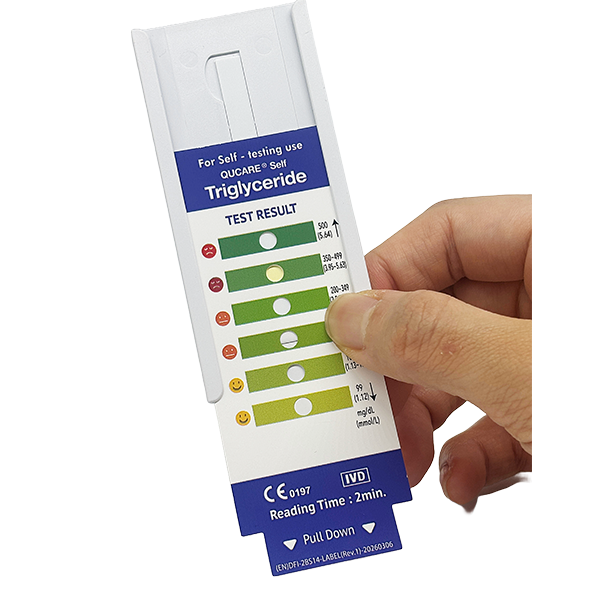
3. Turn it upside down to check the color after 2 min.
Quick FAQ
- When is the best time to test my triglyceride levels?
- For the most accurate results, it is highly recommended to test after fasting for 9–12 hours (usually in the morning before breakfast), as triglyceride levels are significantly affected by recent food intake.
- What do my results mean?
- Compare your result to the color chart. Generally, a normal triglyceride level is less than 150 mg/dL. Levels between 150–199 mg/dL are borderline high, 200–499 mg/dL are high, and 500 mg/dL or higher are considered very high.
- What should I do if my level is high?
- The QUCARE® Self Triglyceride test strip is intended for screening and monitoring. If you obtain a high result, we recommend consulting a healthcare professional to discuss dietary changes, exercise, or medical treatments.
Key Parameters & Clinical Significance
| Parameter | Clinical Significance |
|---|---|
| Triglyceride | Measures the amount of triglycerides in the blood. High levels are closely linked to coronary artery disease, pancreatitis, and metabolic syndrome. |
Ordering Information
| Product Name | Ref no. | Test Strips | Package | Parameters |
|---|---|---|---|---|
| QUCARE® Self Triglyceride test strip | 6420 | 1 | Pouch | Triglyceride |
| 6427 | 2 | Pouch |
Certificates & Regulatory
| Region/Country | Regulation | Scope |
|---|---|---|
| Global | ISO 13485:2016 | Medical Devices (Quality Management Systems) |
| European Union | CE 0197 | Self-Testing according to IVDD 98/79/EC |